Showing posts with label IN YET ANOTHER 10 QUICK FACTS. Show all posts

Saturday, 3 October 2015

’69 IN CANADA, CINCINNATUS, WHO BUILT THE PYRAMIDS AND MORE, IN YET ANOTHER 10 QUICK FACTS

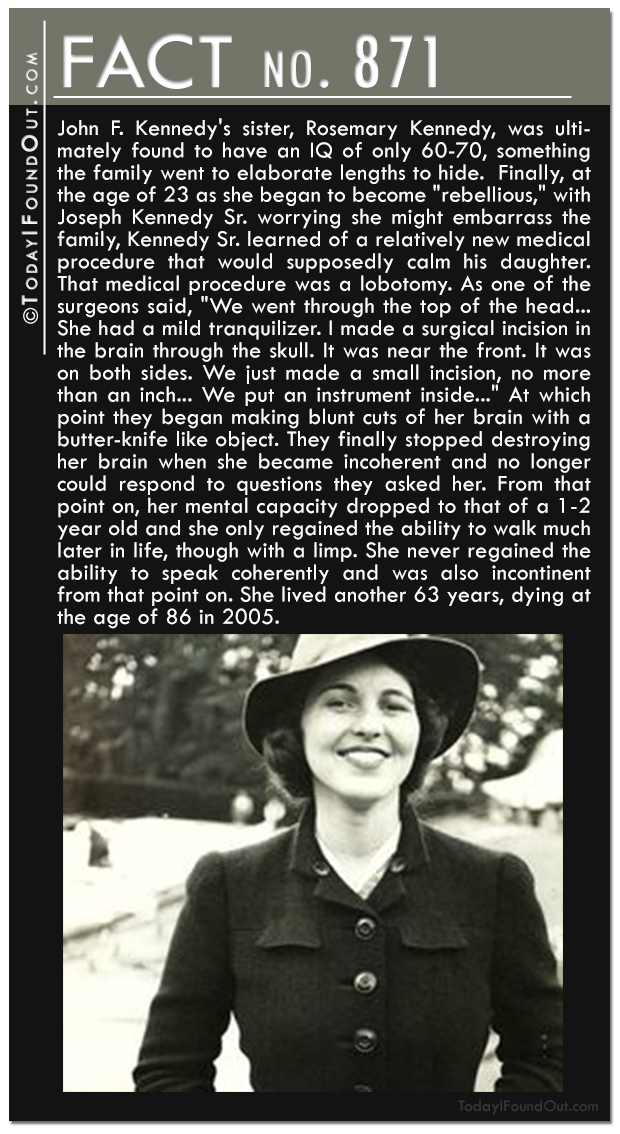
Quick Fact 871: John F. Kennedy’s sister, Rosemary Kennedy, was ultimately found to have an IQ of only 60-70, something the family went to elaborate lengths to hide.  Finally, at the age of 23 as she began to become “rebellious,” with Joseph Kennedy Sr. worrying she might embarrass the family, Kennedy Sr. learned of a relatively new medical procedure that would supposedly calm his daughter.  That medical procedure was a lobotomy. As one of the surgeons said, “We went through the top of the head… She had a mild tranquilizer. I made a surgical incision in the brain through the skull. It was near the front. It was on both sides. We just made a small incision, no more than an inch… We put an instrument inside…” At which point they began making blunt cuts of her brain with a butter-knife like object. They finally stopped destroying her brain when she became incoherent and no longer could respond to questions they asked her. From that point on, her mental capacity dropped to that of a 1-2 year old and she only regained the ability to walk much later in life, though with a limp. She never regained the ability to speak coherently and was also incontinent from that point on. She lived another 63 years, dying at the age of 86 in 2005.

Quick Fact 872: Any month that begins on a Sunday will have a Friday the 13th.

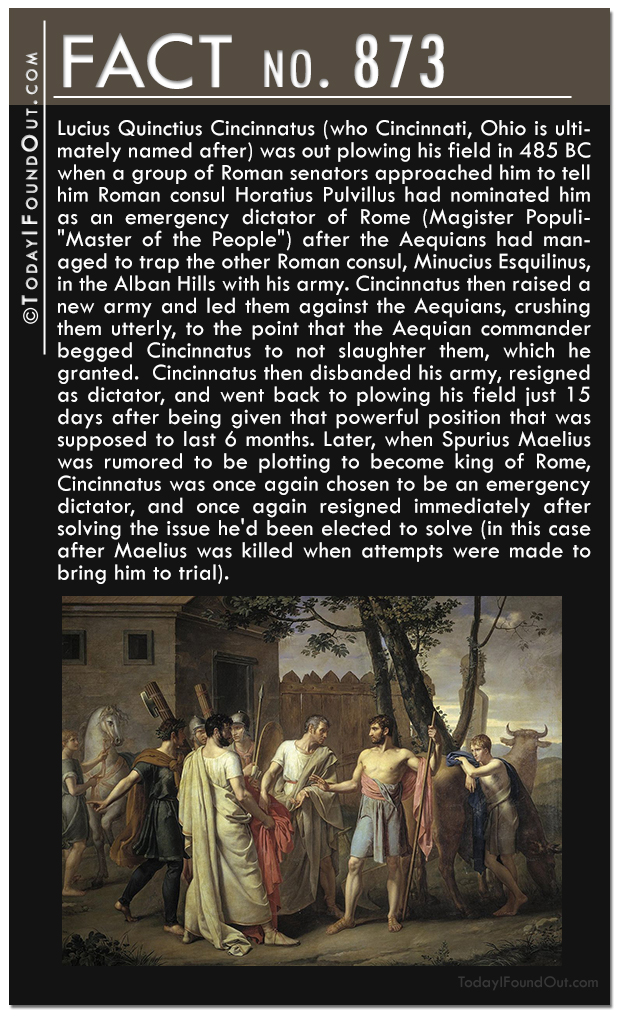
Quick Fact 873: Lucius Quinctius Cincinnatus (who Cincinnati, Ohio is ultimately named after) was out plowing his field in 485 BC when a group of Roman senators approached him to tell him Roman consul Horatius Pulvillus had nominated him as an emergency dictator of Rome (Magister Populi- “Master of the People”) after the Aequians had managed to trap the other Roman consul, Minucius Esquilinus, in the Alban Hills with his army. Cincinnatus then raised a new army and led them against the Aequians, crushing them utterly, to the point that the Aequian commander begged Cincinnatus to not slaughter them, which he granted.  Cincinnatus then disbanded his army, resigned as dictator, and went back to plowing his field just 15 days after being given that powerful position that was supposed to last 6 months. Later, when Spurius Maelius was rumored to be plotting to become king of Rome, Cincinnatus was once again chosen to be an emergency dictator, and once again resigned immediately after solving the issue he’d been elected to solve (in this case after Maelius was killed when attempts were made to bring him to trial).

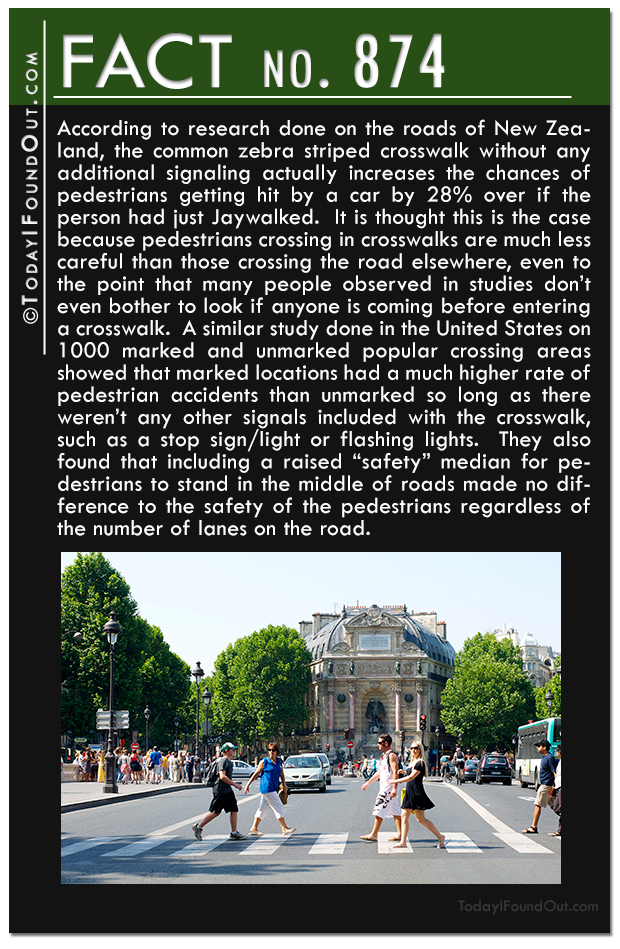
Quick Fact 874: According to research done on the roads of New Zealand, the common zebra striped crosswalk without any additional signaling actually increases the chances of pedestrians getting hit by a car by 28% over if the person had just Jaywalked.  It is thought this is the case because pedestrians crossing in crosswalks are much less careful than those crossing the road elsewhere, even to the point that many people observed in studies don’t even bother to look if anyone is coming before entering a crosswalk.  A similar study done in the United States on 1000 marked and unmarked popular crossing areas showed that marked locations had a much higher rate of pedestrian accidents than unmarked so long as there weren’t any other signals included with the crosswalk, such as a stop sign/light or flashing lights.  They also found that including a raised “safety” median for pedestrians to stand in the middle of roads made no difference to the safety of the pedestrians regardless of the number of lanes on the road.

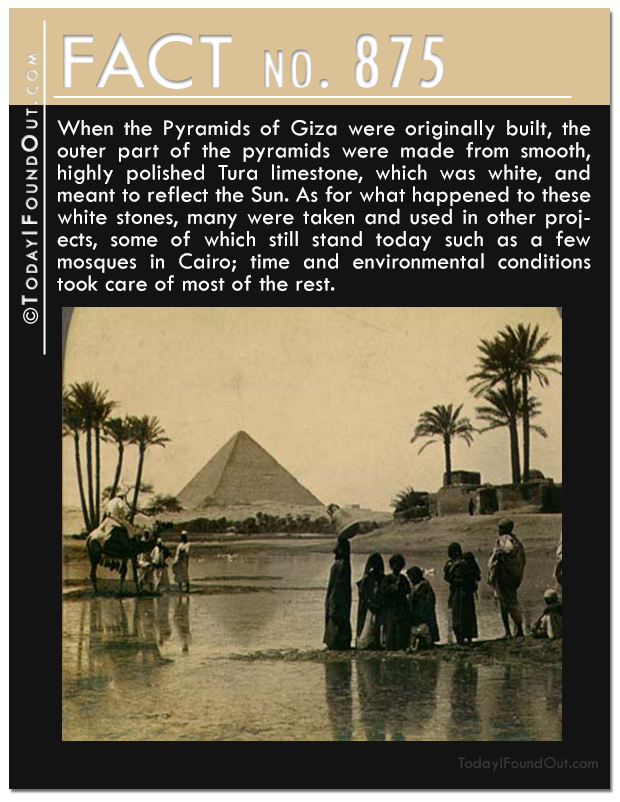
Quick Fact 875: When the Pyramids of Giza were originally built, the outer part of the pyramids were made from smooth, highly polished Tura limestone, which was white, and meant to reflect the Sun. As for what happened to these white stones, many were taken and used in other projects, some of which still stand today such as a few mosques in Cairo; time and environmental conditions took care of most of the rest.

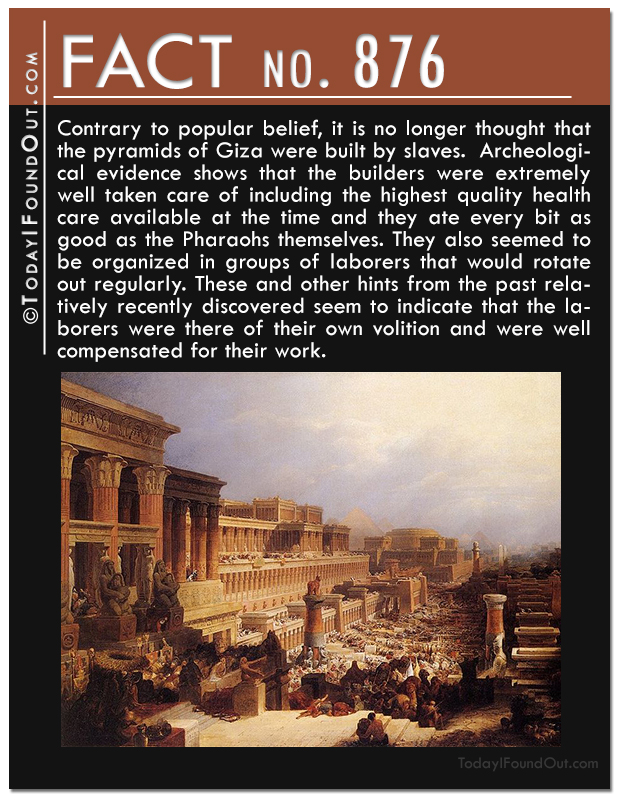
Quick Fact 876: Contrary to popular belief, it is no longer thought that the pyramids of Giza were built by slaves.  Archeological evidence shows that the builders were extremely well taken care of including the highest quality health care available at the time and they ate every bit as good as the Pharaohs themselves. They also seemed to be organized in groups of laborers that would rotate out regularly. These and other hints from the past relatively recently discovered seem to indicate that the laborers were there of their own volition and were well compensated for their work.

Quick Fact 877: In 1887 it was made illegal in Canada to attempt to try to get a woman under 21 years old to have sex with you by promising you would marry her if she did. Punishments for this crime included imprisonment and whipping.

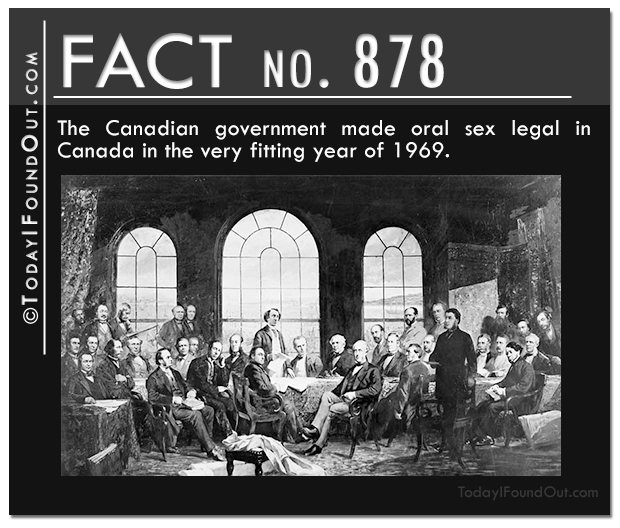
Quick Fact 878: The Canadian government made oral sex legal in Canada in the very fitting year of 1969.

Quick Fact 879: Contrary to popular belief, while there are exceptions, marriage of young teen girls has never been the norm among the vast majority of cultures in history.  For instance, in Medieval Europe, there is a growing body of evidence that the average age of the first marriage of a woman was between 18-22 in most areas, with urban girls in, for instance, Yorkshire, averaging closer to their mid-20s.  More recently, from the 18th through the 19th centuries in England, France, and Germany, the average age for a woman to get married was about 25 years old. Across the pond in America around that time, it was closer to 21-22.  After the Civil War in America, it switched to about 22-24 years old.  Surprisingly, the lowest average age for first marriage since the early 1700s in United States comes from the baby boomer generation of the 20th century, who averaged 20.5 years old for women.  Today, the average age in America for first marriage is 26.1 years old for women and 28.2 years old for men.

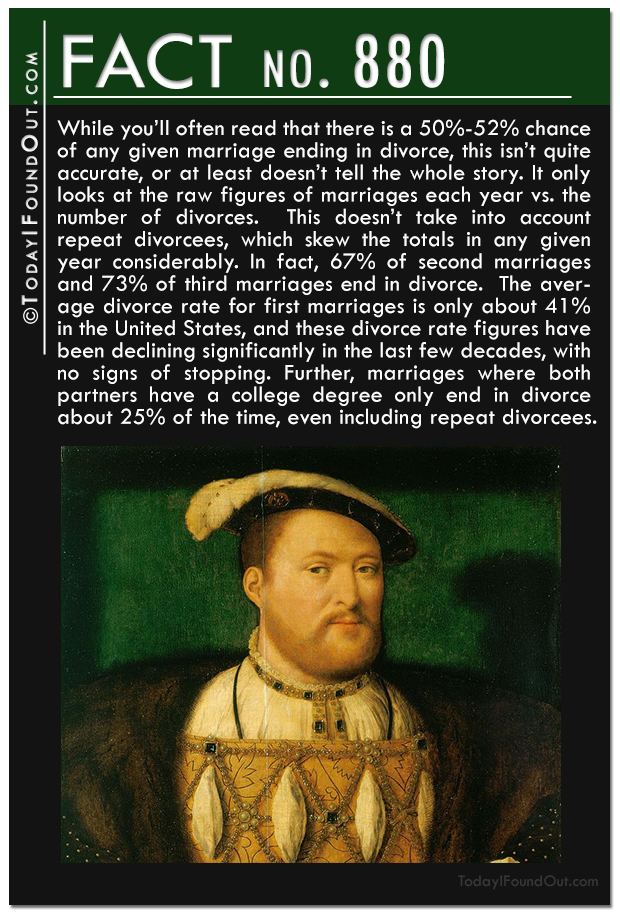
Quick Fact 880: While you’ll often read that there is a 50%-52% chance of any given marriage ending in divorce, this isn’t quite accurate, or at least doesn’t tell the whole story. It only looks at the raw figures of marriages each year vs. the number of divorces.  This doesn’t take into account repeat divorcees, which skew the totals in any given year considerably. In fact, 67% of second marriages and 73% of third marriages end in divorce.  The average divorce rate for first marriages is only about 41% in the United States, and these divorce rate figures have been declining significantly in the last few decades, with no signs of stopping. Further, marriages where both partners have a college degree only end in divorce about 25% of the time, even including repeat divorcees.

THE SACRED BAND OF THEBES, WHAT MONKEES DO WITH MONEY AND MORE, IN YET ANOTHER 10 QUICK FACTS

Quick Fact 881: On February 10, 1355 in Oxford, England, Walter Spryngeheuse and Roger de Chesterfield, two students at Oxford University, got in an argument with tavern owner John Croidon over the quality of the drinks he was serving.  In the end, drinks were thrown in the face of Croidon, after which the two students attacked him.  Soon the fight spread, with local townspeople on one side and Oxford students on the other, including the students assaulting the mayor of Oxford, John de Bereford.  The riot lasted two days, leaving 63 students and about 30 locals dead and many more injured.  For the next 470 years, the mayor of Oxford and its councilors had to march through the streets of Oxford on February 10th each year with bare heads, as well as give one penny annually for each of the students killed.  This finally ended in 1825 when the mayor refused to do the penance.

Quick Fact 882: Next time you decide you’d like to just stay in bed all day and call in sick from work, simply tell your boss you’re suffering from clinomania- the excessive desire to stay in bed.

Quick Fact 883: In 1916, a proposed amendment to the U.S. Constitution was that anytime the U.S. wanted to commit and act of war, it should have to be voted on by U.S. citizens. Further, if you voted “Yes,” you would then be obliged to join the U.S. army as a volunteer. In 1936, a similar amendment was proposed, this time just trying to make it so anytime the nation’s elected leaders felt the U.S. should go to war, a national vote would be held to determine this.

Quick Fact 884: In 1893, an amendment was proposed to the U.S. Constitution trying to get the United States of America renamed the “United States of Earth.”

Quick Fact 885: For a period of 50 years in the 4th century B.C. a small force of 300 elite Theban soldiers dominated Grecian battlefields. What makes this band of brothers unique in history is that it was comprised entirely of male lovers, with each pair comprising of an erastes (the older man and mentor, called “lover”) and eromenos (the younger male and trainee, called “beloved”).   The deep attachment this pairing forged between the two males was seen as a military advantage.  Indeed, the Sacred Band were an incredible fighting force. For instance, the Band’s first victory was against a much larger Spartan force in 375 B.C., with one of the Band’s soldiers, according to Plutarch, remarking, “We have fallen into our enemies’ hands!” To which the leader of the Band, Pelopidas, remarked, “Why any more… than they into ours?” The Sacred Band crushed the much larger Spartan force; the first time in recorded history a Spartan army had been defeated by an army with inferior numbers. Their extreme loyalty to one another ultimately led to their utter defeat in 338 B.C. at the Battle of Chaeronea, when a young Alexander the Great, under his father Philip II of Macedonia, managed to defeat them. Because they would not leave one another or their fallen partners to retreat, the entire Band was killed.  According to Plutarch, the victor, Philip II, wept over their bodies. Later, a massive stone lion was erected over their burial site.

Quick Fact 886: Victor Lustig was a con-artist who managed to sell the Eiffel Tower to a scrap metal dealer and get away with it. He used forged government documents, combined with newspaper articles lamenting how expensive the tower was for the city to maintain. With the first sale, he not only was paid for the Eiffel Tower, but also managed to get a bribe by the contractor who wanted his bid to be chosen. He then fled Paris, only to return a month later when the winning contractor, Andre Poisson, didn’t report the matter to the police because of the embarrassment it would have brought. Lustig then tried to sell the tower again, this time, though, the winning bidder double checked with the authorities before paying, ultimately finding out it was a scam. However, Lustig was able to flee before he could be arrested. He was ultimately captured in America and charged with unrelated crimes after he was turned in by his girlfriend, Billy May, who had found out he was sleeping with another woman.  Hell hath no fury and all that.  He died of pneumonia in Alcatraz in 1947 while serving a 20 year prison sentence.

Quick Fact 887: On September 17, 1951, 22 year old Herbert Pililaau found himself fighting for his life against the North Korean army on what would become known as Heartbreak Ridge.  His squad was tasked with covering a retreat. When it was time, Pililaau ultimately volunteered to cover the retreat of his squad, telling his commanding officer to go on without him. U.S. soldiers watching from far above then witnessed Pililaau first exhausting his ammunition, then expending all his hand grenades, at which point, rather than retreat, he began throwing rocks at the advancing North Korean soldiers.  Once the enemy soldiers reached him, he pulled out his trench knife and leapt upon them, stabbing with one arm and punching with the other. The next day, U.S. soldiers found Pililaau’s body… and the bodies of 40 North Korean soldiers he managed to kill before he was stabbed to death. For his actions, Pililaau became the first Hawaiian to be awarded the Medal of Honor.

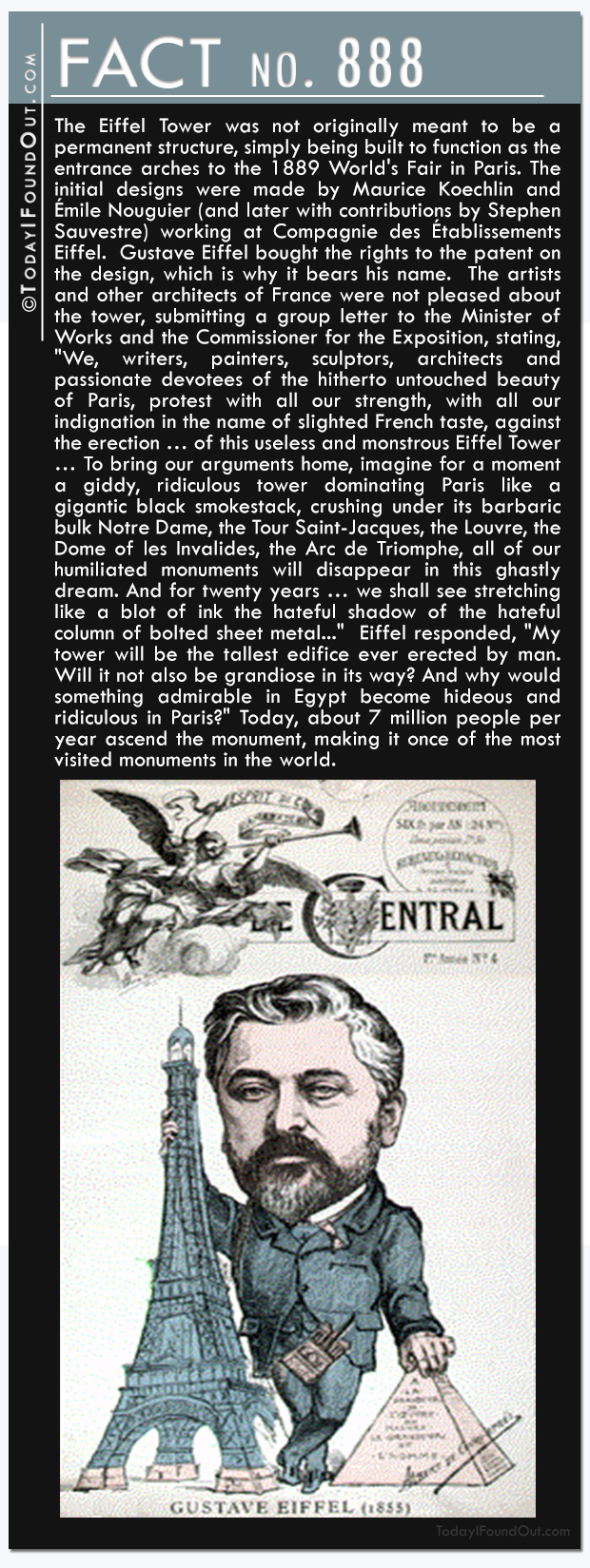
Quick Fact 888: The Eiffel Tower was not originally meant to be a permanent structure, simply being built to function as the entrance arches to the 1889 World’s Fair in Paris. The initial designs were made by Maurice Koechlin and Émile Nouguier (and later with contributions by Stephen Sauvestre) working at Compagnie des Établissements Eiffel.  Gustave Eiffel bought the rights to the patent on the design, which is why it bears his name.  The artists and other architects of France were not pleased about the tower, submitting a group letter to the Minister of Works and the Commissioner for the Exposition, stating, “We, writers, painters, sculptors, architects and passionate devotees of the hitherto untouched beauty of Paris, protest with all our strength, with all our indignation in the name of slighted French taste, against the erection … of this useless and monstrous Eiffel Tower … To bring our arguments home, imagine for a moment a giddy, ridiculous tower dominating Paris like a gigantic black smokestack, crushing under its barbaric bulk Notre Dame, the Tour Saint-Jacques, the Louvre, the Dome of les Invalides, the Arc de Triomphe, all of our humiliated monuments will disappear in this ghastly dream. And for twenty years … we shall see stretching like a blot of ink the hateful shadow of the hateful column of bolted sheet metal…”  Eiffel responded, “My tower will be the tallest edifice ever erected by man. Will it not also be grandiose in its way? And why would something admirable in Egypt become hideous and ridiculous in Paris?” Today, about 7 million people per year ascend the monument, making it once of the most visited monuments in the world.

Quick Fact 889: On July 1, 2010, Finland became the first nation in the world to make internet access a legal right for its citizens, requiring at that time that internet access providers make available for purchase a minimum of a 1 Mbps connection within 2 km of every Finnish citizen, no small feat considering certain very remote regions of the country.  Their original plan was to increase this to 100 Mbps by 2015, something that supposedly is close to happening. However, Finnish citizens are required to pay for the last step lines to their door, which in extreme remote regions may mean paying for the full 2 km of the last leg of the line. So, many in such regions just go with slower cellular connections instead.

Quick Fact 890: At Yale-New Haven hospital, economist Keith Chen and psychologist Laurie Stanos taught capuchin monkeys to use money.  Among other fascinating results from this study was an interesting incident where one monkey managed to steal an entire tray of money tokens and flung them into the main cage that housed all the monkeys before it could be caught.  The monkeys then all scrambled for the coins.  With the temporary surplus of money, allowing for expenditures beyond food, and the fact that the monkeys had no concept of saving, one of the monkeys decided to pay another monkey for sex. Since that exchange, steps were taken to assure the monkeys would no longer be able to pay one another for sexual acts.